
Sex Sells
and misogyny abounds / a rant


Of all the bands that emerged out of England during the punk era, The Stranglers were among the very few who were expert at playing their instruments. A hallmark of punk rock’s musical aesthetic was that you didn’t have to be adept or even good in order to perform it. Punk rock was about expression, and growing up in public was also part of the vibe. Punk meant you could JUST DO IT.
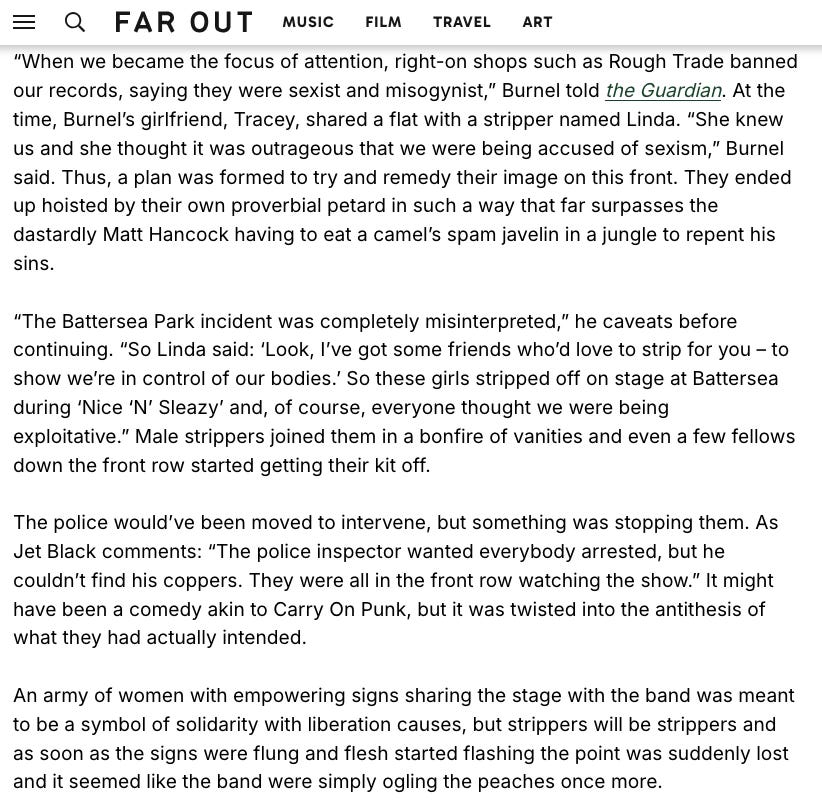
The Stranglers headlined five nights at the Whisky a GoGo in November of 1980, a month that included multi-night stands by Siouxsie and the Banshees, The Slits, and Nina Hagen as well. During a month of strong women fronting bands, The Stranglers were a strong band confronting women. People talked about their misogyny, their sexism, journalists made this sexism the focal point of Stranglers stories, and 40+ years later, in retrospect, they’re all still talking about it. The image below is from the UK’s Far Out magazine, December 2022. It took Jett Black’s death at the age of 84 as an occasion to review The Stranglers’ reputation as sexists.
On one of the nights The Stranglers played at the Whisky, sure enough, a stripper joined them on stage. From the look on Hugh Cornwell’s face, he does seem surprised at the spontaneity of this dancer.
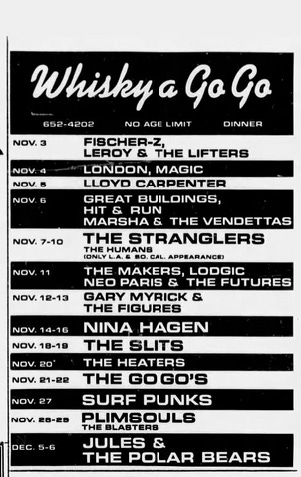
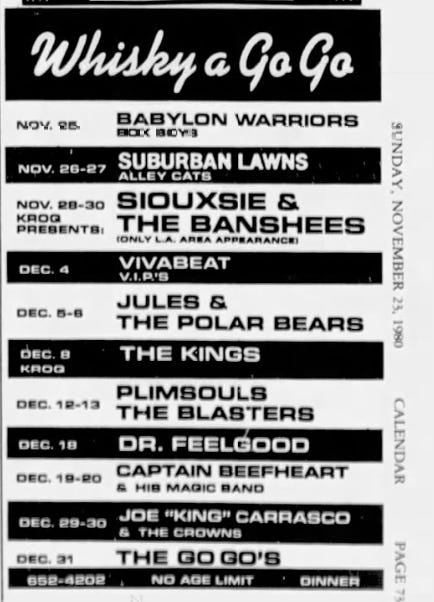
Meanwhile, a few days later, as you can see from the Whisky A GoGo ads, women commanded the stage - Nina Hagen, The Slits, The Heaters, and The GoGo’s. The following week, Siouxsie and the Banshees headlined, and the club featured other women-led bands in Vivabeat, Suburban Lawns, and The Alley Cats.


Sex as a selling point comes two-fold with women, turning the Madonna/Whore concept into a pretzel where neither role is acceptable, nor is the middle ground.
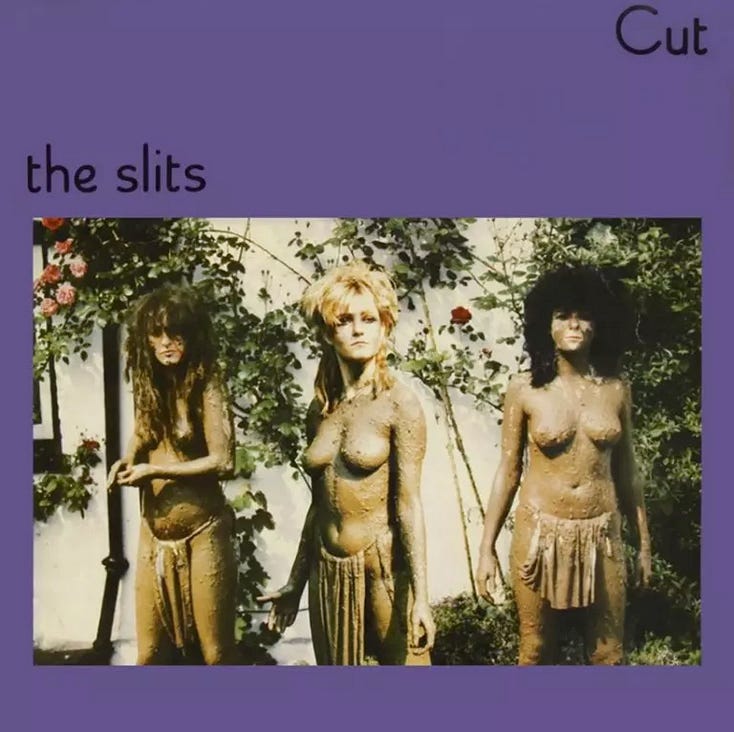
When The Slits’ album CUT was released, the band caught a lot of flak for the cover, where they are covered in mud, wearing loincloths and bare breasts. While some critics of the album art called it exploitative, another set of critics attacked the punk trio’s appearance as rude, crude, and that age-old insult: they were fat (and they clearly are not).
Again, consideration of their music was an afterthought in music and critical reviews.
But this band exemplified everything punk. The music itself was a celebration of punk invention, spunkiness, and insouciance. The renowned reggae studio master, Dennis Bovel produced it, and he brought all the gifts he brought to other artists he produced - such as the slinky bass and dub sounds a la his work with Linton Kwesi Johnson. Budgie (Siouxsie and the Banshees) delivers a crisp crack to the Slits’ gleeful, scratchy, pop punk, yielding angular sounds ripe for pogoing. The Slits were decades ahead of their time and continue to influence bands’ sounds and messages. They seemed to be trying to say, “the future is feral and female.”
“Women in Rock” was always a topic for publications when they ran out of other ideas. I got to take advantage of that in my fledgling career, as well as decades on down the line. As a woman making photographs, I was assigned to illustrate such stories, and I was happy to do so.
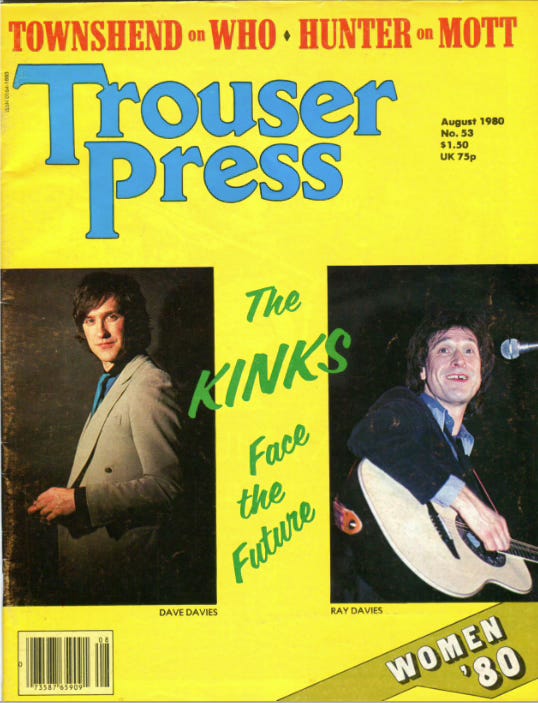
Notice that the feature about “Women ‘80” is at the bottom of the cover of Trouser Press, August 1980? I’m not blaming editor/publisher Ira Robbins, it was the zeitgeist- “the plus ca change plus ca meme chose” zeitgeist. Women were an asterisk, despite the numbers showing that their sex sells. Not their sex appeal, their identity as females. THAT was the selling point, not their appearance. Rolling Stone, which started as a counter cultural zine, and a real benchmark in the history of contemporary music reporting lost that lustre and became just another publication when they ghettoized women, featuring them as a group, or a genre, absent a woman being a superstar and able to command a cover based on her - gasp - talent and accomplishments. Of the 10 times Tina Turner appeared on the cover of Rolling Stone, she was the sole persona on only five of those covers.


And let’s look at the Go-Go’s treatment on their Rolling Stone covers. The first time they were on the cover, photographed by Annie Leibowitz, they were styled in underwear - tightie whities and not lingerie, but one would expect that a woman photographer wouldn’t cave to the “sex sells” aspect of making an image of an all-woman band; but she did. Yes, the band members are my friends, and we came up together in the OG LA punk days (and Belinda Carlisle and I in high school), so I am extra sympathetic, but their experience exemplifies how while our sex sells, women still get no respect.
When The Go-Go’s were finally inducted into the Rock and Roll Hall of Fame, for many of us - fans and women specifically, there was a collective sigh: “it’s about fucking time.” I may even have a t-shirt with that comment on it!
Go-Go’s bassist (and writer of “Vacation”) Kathy Valentine made a poignant acceptance speech that has stuck with me, especially this line: “Because here is the thing: There would not be less of us if more of us were visible.” You can watch and read it here.
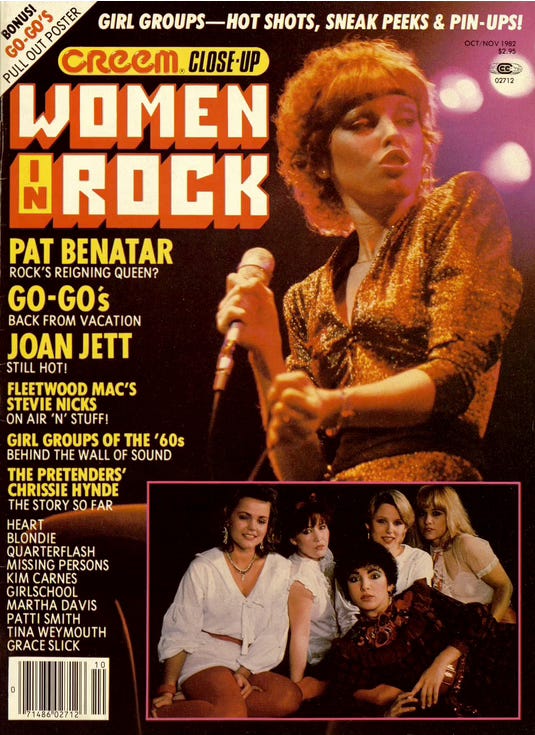
Even the irreverent CREEM magazine published a special WOMEN IN ROCK issue (with a BONUS! Go-Go’s pull out poster) when they (and all the other publications) could have just put more women on their covers and featured more women on the regular. In 1982, when this special issue was published, Joan Jett was on CREEM’s June cover; Pat Benatar and the Go-Go’s were included in a collage, and the B-52s, with two women in the group, were on another cover.
The lack of respectable coverage was rivaled by only the chauvinism in it. Women artists were evaluated more by their appearance than their talents. In 1982, the year we are reviewing here, a woman-fronted band started making some noise in Los Angeles- Lone Justice. I knew of them through a co-worker’s then-boyfriend-soon-to-be-husband, the musician/producer, Marvin Etzioni, who wrote songs for the band and eventually joined them. Maria McKee fronted the band. She was young and beautiful and her talents as a vocalist far outshined her exceptional beauty. The band was one of those “buzz bands,” but that buzz was absolutely deserved. Dolly Parton and Linda Ronstadt were fans and attended Lone Justice nightclub gigs. Hell - EVERYONE in Los Angeles was a fan - everyone. Legend has it that Linda Ronstadt was so taken by them, she called David Geffen to sing their praises, and that was all he needed to sign them to his label; their eponymous debut was released in 1985. Despite making one of the strongest debut records I can remember, they failed to gain the commercial success the label was expecting. I don’t know what the label thought when all the publicity seemed to focus on McKee’s beauty and the band’s famous fans rather than on the strength of the music.
I have ideas, but they’re my ideas… I was living in Dublin at the time the record was released, and one of the people in my crowd was a Geffen Records staffer, and I felt that even she didn’t understand the band was a band, and not a “hot chick fronting a few dudes,” and as such, I felt that the label was part of the problem.
It is a wonder that The Go-Go’s and The Bangles, two all-women bands who wrote their own songs and played their instruments, managed to break through this sexist muck. There is room for everyone, so let them in! It was commonplace for labels to say to managers presenting women artists for possible signing that they already had A woman on their artist roster… because apparently there’s a quota?
I also wonder if a man had spoken out and perhaps tore up a picture of the Pope instead of Sinead O’Connor, would he have been excoriated? If a man had criticized then President George W. Bush, would his career have been cancelled the way country music cancelled The (Dixie) Chicks? Some bro-country artists have committed crimes and hate speech, yet while their transgressions are pointed out, their careers continued to thrive.
Style over substance is a millennia-old problem. I do wish we could break that habit. I prefer a different interpretation of the story A STAR IS BORN (give me 1937’s Janet Gaynor!), but that’s neither here nor there - the Bradley Cooper/Lady GaGa version illustrated how the female artist was treated like a puppet, a sexualized puppet, in order to get record label support. It hasn’t changed at all in these modern or postmodern times.
As I mentioned in the subtitle, this is a rant…. I was thinking that this weekend celebrates the birth of Madonna, Belinda Carlisle, and Maria McKee… and I noted that while she is a hugely successful, Madonna is often criticized for the very traits that brought her that success - work ethic, outspokenness, demanding to be taken seriously and in control of her work; I knew all the trials and tribulations of The Go-Go’s in real time; and lastly, decades later, I continue to bemoan how Maria McKee’s career seemed like an afterthought to the label that valued her beauty over her talent.
And a rant was born.
You’ll have to connect your own dots.
Good rant! I’ve lately been rediscovering Concrete Blonde, a great 80s LA band fronted by Johnette Napolitano. She shrugged off the demands to sexualize her persona. She’s a powerful rock singer.
All great points, Theresa. I see it all the time on the Hoffman forums where there is the attitude that the reason there aren't many women in the rock hall of fame is that women didn't want to play rock music when there are UK reissue labels finding and reissuing all kinds of rock records from women in the 60s who are the equal of or better than their male counterparts who got the breaks. Or even the infamous Rolling Stone issue that shamed Joni Mitchell as old lady of the year way back in the early 70s. It really gets under my skin to see that few attitudes have changed even now with the accusations that Wet Leg and Last Dinner Party are industry plants. It's a bit of a messy rant, I know, but I'm just sick of it.